



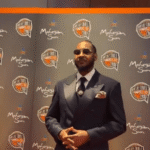

Dennis Schröder Brings a New Kind of School Home to Braunschweig

Dennis Schröder has long been one of Germany’s most visible basketball exports, but his latest project has nothing to do with the NBA, EuroBasket, or the national team. Instead, he’s investing in something far more personal: a new bilingual elementary school in his hometown of Braunschweig, designed to give local children access to the kind of global education Germany’s traditional system rarely offers.
For Schröder, the idea isn’t about attaching his name to a building. It’s about creating opportunities he believes can shape a child’s entire future—opportunities he didn’t see growing up.
A School Built for a Changing World
The project, a partnership with the Oskar Kämmer Schule (OKS), one of the region’s largest private educational providers, aims to open its doors for the 2026–27 school year. Informally called the “Dennis Schröder International School,” the institution will function as a bilingual primary school with a kindergarten planned for the following year.
OKS already oversees more than 50 schools, but this one follows a very specific blueprint: the Kämmer International Bilingual School (KIBS) model developed in Hanover. Rather than treating English as a subject squeezed between math and science, the school uses immersion—kids hear and use English daily, taught by native or near-native speakers who make the language feel natural from the start.
The curriculum will still follow Lower Saxony’s state standards, but with additional language depth, cultural education, and international frameworks. Over the years, students will have the option to sit for Cambridge English examinations that correspond roughly to A2 through B2 proficiency. For a primary school, that’s unusually ambitious—and intentionally so.
Starting Small, Thinking Big
The school is slated to launch on the OKS campus on Moselstraße, using existing buildings at first. While many city-backed projects move slowly, this one has a clearer timeline: classrooms opening in 2026–27 and a new daycare building (Kita) expected around 2027–28 pending approval. The goal is to stitch kindergarten and primary education together so families have continuity from early childhood through the end of elementary school.
Smaller class sizes—capped around two dozen students—are central to the design, as is the full-day structure. Extended care options will also be offered, giving families more flexibility and creating more time for language immersion. Tuition will be income-based, keeping the doors open to families who might otherwise be shut out of private education.
Schröder’s Role: More Than a Namesake
While OKS handles the educational framework, Schröder is an essential piece of the puzzle. He is contributing funding, visibility, and a level of public trust that helps push the vision forward in Braunschweig. Local leaders and school officials frequently describe him as the project’s driving force—someone using his platform to introduce a global model to a city that has long taken a more traditional approach.
Schröder’s involvement also sends a message to the community: you can grow up in Braunschweig and still think globally. For kids who rarely see representation at the highest levels of international sports or business, seeing a hometown athlete invest in education—not just facilities, camps, or jerseys—carries a different kind of weight.
Why It Matters
Germany’s bilingual and international school landscape has expanded in major metropolitan areas, but regions like Lower Saxony haven’t seen that same growth. Schröder’s project fills a gap: a school that gives children early exposure to global culture and language without requiring families to relocate or pay elite-level tuition.
It’s also a reminder that athletes can shape their communities in ways that outlast their playing days. Courts and camps are impactful, but a school—one that prepares generations of kids for a wider world—is a different kind of legacy.
When the doors open in 2026, the students who walk in won’t just be entering a building. They’ll be stepping into a vision Schröder wished existed when he was their age: an education that speaks multiple languages and reaches beyond the borders of the city where he first dribbled a ball.





Leave a comment